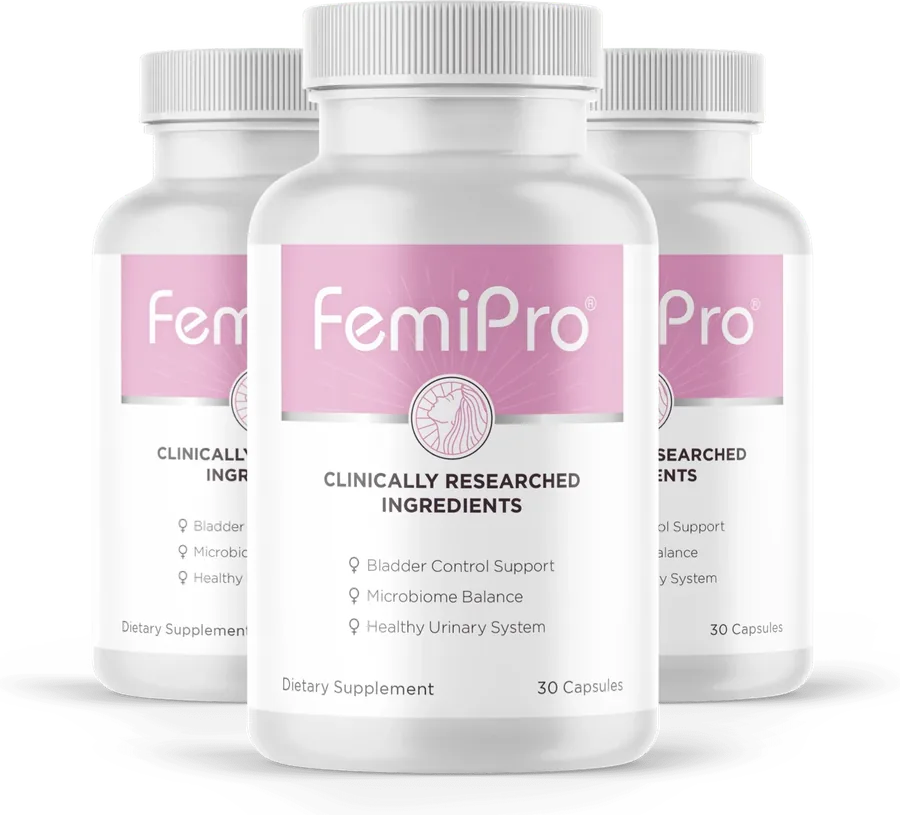
Ingredients
FemiPro Ingredients: Nine Label Lines in Two Blends
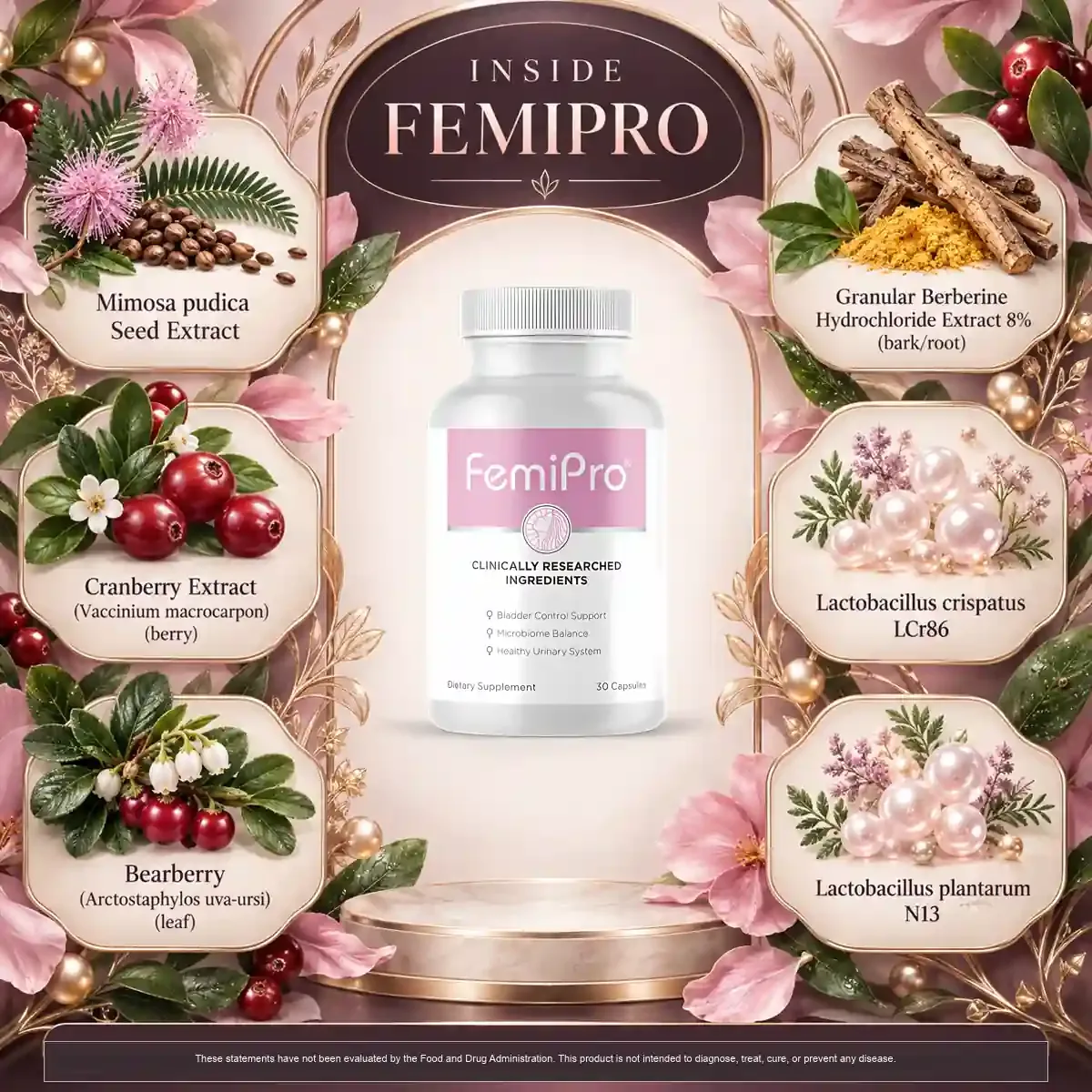
FemiPro has nine ingredients: four herbs and five probiotic strains.
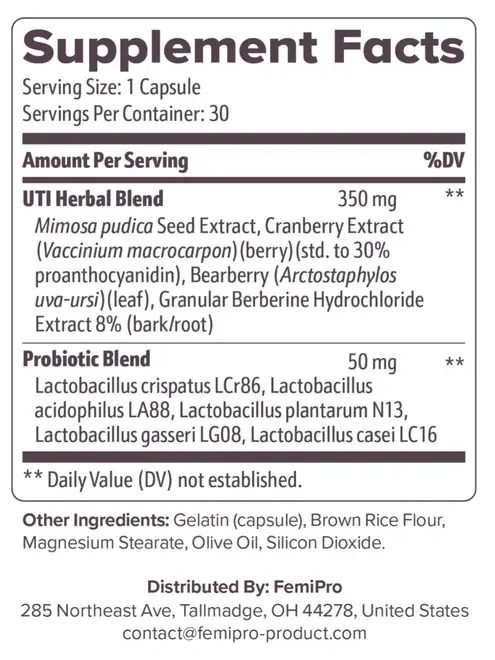
The herbs (Mimosa pudica seed, cranberry, bearberry leaf and berberine) share a 350 mg blend, and the five Lactobacillus strains share a 50 mg blend. No single amount is printed on the label.
Written by the FemiPro label deskUpdated
The list01
What are the FemiPro ingredients?
The FemiPro ingredients are four herbal lines and five probiotic strains. The herbs sit in the 350 mg "UTI Herbal Blend". The strains share a 50 mg "Probiotic Blend".
Each line keeps its label order, which drives the math below.
- 1Mimosa pudica Seed ExtractUTI Herbal Blend line 1 · at most 350 mg
- 2Cranberry Extract (Vaccinium macrocarpon) (berry) (std. to 30% proanthocyanidin)UTI Herbal Blend line 2 · at most 175 mg
- 3Bearberry (Arctostaphylos uva-ursi) (leaf)UTI Herbal Blend line 3 · at most 116.7 mg
- 4Granular Berberine Hydrochloride Extract 8% (bark/root)UTI Herbal Blend line 4 · at most 87.5 mg
- 1Lactobacillus crispatus LCr86Probiotic Blend line 1 · at most 50 mg
- 2Lactobacillus acidophilus LA88Probiotic Blend line 2 · at most 25 mg
- 3Lactobacillus plantarum N13Probiotic Blend line 3 · at most 16.7 mg
- 4Lactobacillus gasseri LG08Probiotic Blend line 4 · at most 12.5 mg
- 5Lactobacillus casei LC16Probiotic Blend line 5 · at most 10 mg
From the Supplement Facts panel on the label. Each blend lists its lines from most to least by weight (21 CFR 101.36, supplement labeling). Other ingredients (the gelatin capsule, brown rice flour, magnesium stearate, olive oil, silicon dioxide) are not counted.
Profiles03
What is each FemiPro ingredient used for?
Each FemiPro ingredient has a different research story, and none was tested inside this capsule. Cranberry has the most human data, for repeat UTIs in women prone to them (Cochrane 2023, cranberries for preventing UTIs).
Mimosa pudica seed rests on traditional use (Muhammad 2016, Mimosa pudica review). Berberine was studied for blood sugar and lipids, not the bladder (Berberine umbrella review, 2023).
-
 Herbal line 1 of 401
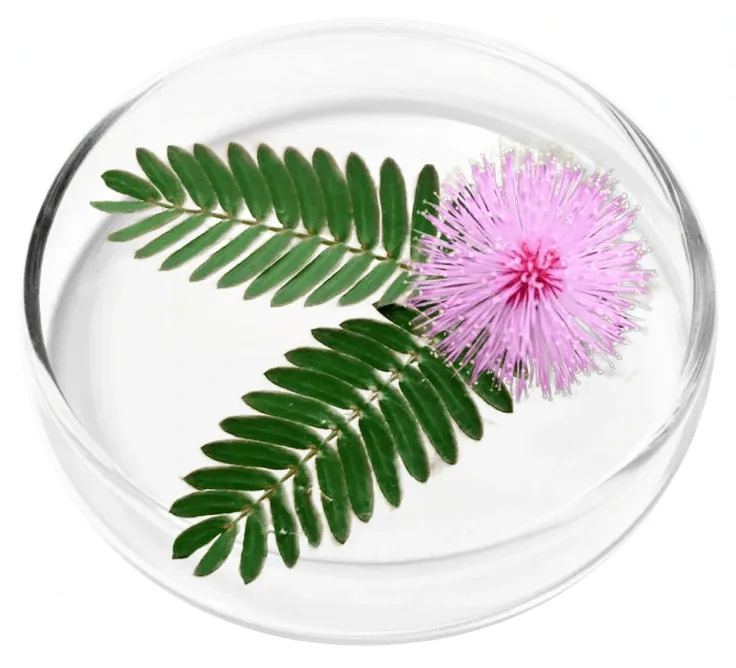
Mimosa pudica seed
Herbal line 1 of 4: the largest share
Seed of the 'sensitive plant', a creeping legume whose leaves fold when touched
Evidence: Traditional use and lab data; no human bladder trialVendor photo of the plant, not the capsule's contents.
Per capsuleat most 350 mg by label order (line 1 of 4 in 350 mg)
Studied atNo human dose established
Watch forNo human safety trials found; traditional use only.
Full profile -
 Herbal line 2 of 402
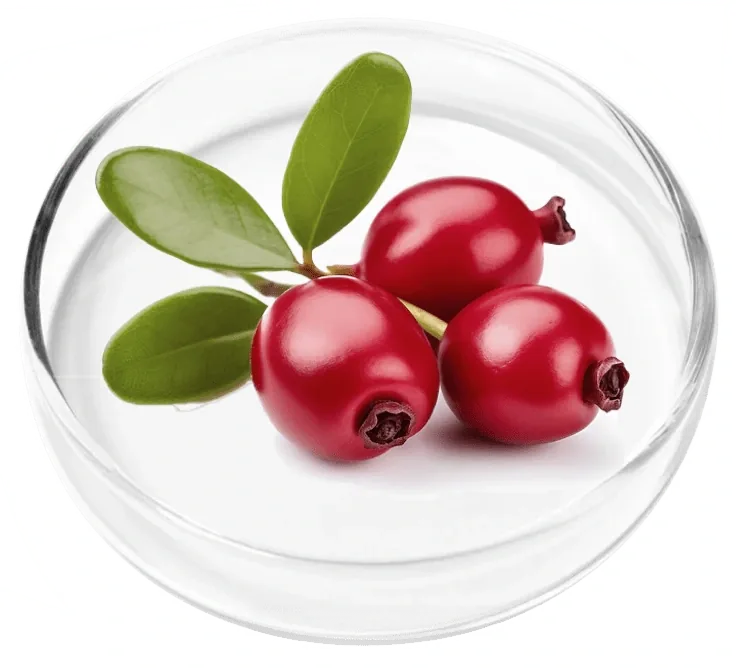
Cranberry extract
Herbal line 2 of 4: standardized to 30% PACs
American cranberry fruit extract, standardized to 30% proanthocyanidins (PACs)
Evidence: Moderate: fewer repeat UTIs in women prone to them; not a treatmentVendor photo of whole cranberries, not the extract.
Per capsuleat most 175 mg by label order (line 2 of 4 in 350 mg)
Studied atTrials used many juices, tablets and doses; no single PAC dose is set
Watch forWarfarin evidence is conflicting: ask first if you take it. Kidney-stone data are mixed.
Full profile -
 Herbal line 3 of 403
Bearberry (uva-ursi)
Herbal line 3 of 4: a short-course herb
Leaf of a low evergreen shrub; contains arbutin, which forms hydroquinone
Evidence: Traditional use only; few modern trialsCut from the vendor's ingredient graphic; artwork, not a lab photo.
Per capsuleat most 116.7 mg by label order (line 3 of 4 in 350 mg)
Studied atEU traditional use: adult women, for no longer than one week
Watch forShort courses only (hydroquinone); EMA says no longer than one week and not with kidney disorders.
Full profile -
 Herbal line 4 of 404
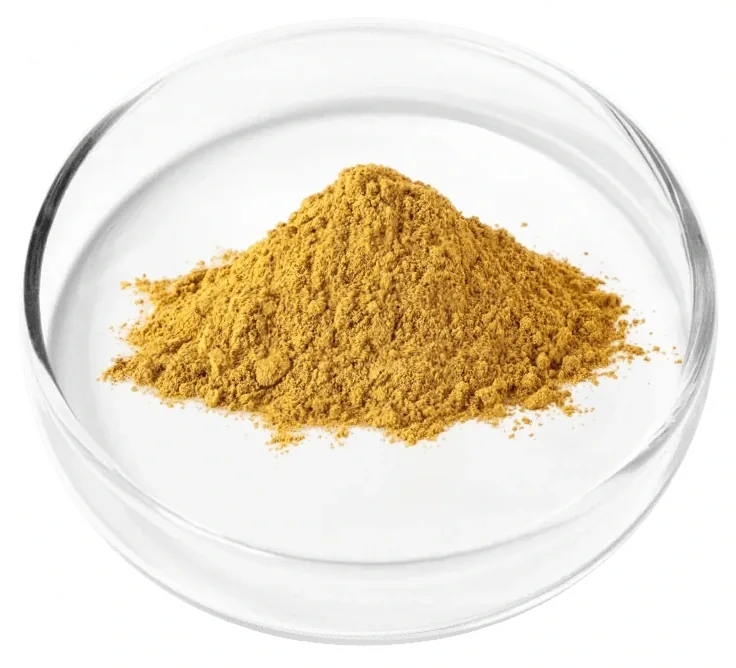
Berberine
Herbal line 4 of 4: the smallest herbal share
A yellow plant alkaloid from bark and root (for example barberry or goldenseal); the label does not name the plant
Evidence: Studied for blood sugar and lipids, not for the bladderVendor photo of a yellow powder. It is not labeled; berberine is a bright yellow compound.
Per capsuleat most 87.5 mg by label order (line 4 of 4 in 350 mg)
Studied atUsual herbal dose 250-500 mg two or three times a day
Watch forNot in pregnancy, while nursing or for newborns; changes how the body handles many drugs.
Full profile -
 5 strains · 50 mg05
The 5 probiotic strains
Probiotic Blend: 5 strains share 50 mg
A lactic-acid bacterium common in a healthy vaginal microbiome
Evidence: Strain LCr86: no published human trial foundVendor illustration of rod-shaped bacteria, not a microscope image.
Per capsule5 strains share 50 mg: at most 50 mg for the first, about 10 mg each on average; no CFU count
Studied atTrials of a different strain (CTV-05) used vaginal inserts, not capsules
Watch forGenerally well tolerated; caution with a weakened immune system.
Full profile
Per capsule04
How much of each FemiPro ingredient could one capsule hold?
One FemiPro capsule could hold up to 350 mg of Mimosa pudica, up to 175 mg of cranberry extract and up to 116.7 mg of bearberry leaf. These are ceilings from the label order, not amounts.
At 30% PACs, 175 mg of cranberry extract carries at most about 52 mg of PACs.
| Label line | Blend and place | Most per capsule | Amount used in research | Evidence |
|---|---|---|---|---|
| Mimosa pudica Seed Extract | UTI Herbal Blend, line 1 | at most 350 mg | No human dose established (Muhammad 2016, Mimosa pudica review) | Traditional use and lab data; no human bladder trial |
| Cranberry Extract (Vaccinium macrocarpon) (berry) (std. to 30% proanthocyanidin) | UTI Herbal Blend, line 2 | at most 175 mg | Trials used many juices, tablets and doses; no single PAC dose is set (Cochrane 2023, cranberries for preventing UTIs) (NCCIH, Cranberry) | Moderate: fewer repeat UTIs in women prone to them; not a treatment |
| Bearberry (Arctostaphylos uva-ursi) (leaf) | UTI Herbal Blend, line 3 | at most 116.7 mg | EU traditional use: adult women, for no longer than one week (EMA/HMPC, Uvae ursi folium (bearberry leaf)) (LiverTox, Uva Ursi) | Traditional use only; few modern trials |
| Granular Berberine Hydrochloride Extract 8% (bark/root) | UTI Herbal Blend, line 4 | at most 87.5 mg | Usual herbal dose 250-500 mg two or three times a day (Berberine umbrella review, 2023) (LiverTox, Berberine) | Studied for blood sugar and lipids, not for the bladder |
| Lactobacillus crispatus LCr86 | Probiotic Blend, line 1 | at most 50 mg | Trials of a different strain (CTV-05) used vaginal inserts, not capsules (Cohen et al. 2020 NEJM, Lactin-V and bacterial vaginosis) (Stapleton et al. 2011, L. crispatus and recurrent UTI) | Strain LCr86: no published human trial found |
| Lactobacillus acidophilus LA88 | Probiotic Blend, line 2 | at most 25 mg | Studies dose probiotics in CFU, not milligrams (NCCIH, Probiotics: usefulness and safety) | Strain LA88: no published human trial found |
| Lactobacillus plantarum N13 | Probiotic Blend, line 3 | at most 16.7 mg | Studies dose probiotics in CFU, not milligrams (NCCIH, Probiotics: usefulness and safety) | Strain N13: no published human trial found |
| Lactobacillus gasseri LG08 | Probiotic Blend, line 4 | at most 12.5 mg | Studies dose probiotics in CFU, not milligrams (NCCIH, Probiotics: usefulness and safety) | Strain LG08: no published human trial found |
| Lactobacillus casei LC16 | Probiotic Blend, line 5 | at most 10 mg | Studies dose probiotics in CFU, not milligrams (NCCIH, Probiotics: usefulness and safety) (Cochrane 2015, probiotics for preventing UTIs) | Strain LC16: no published human trial found |
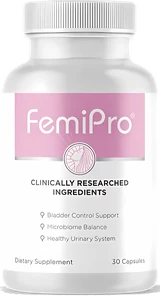
FemiPro: from $49 a bottle30 capsules · 1, 3 or 6 bottles · free US shipping · 60-day money-back guarantee
See packsProbiotics05
What is in the FemiPro probiotic blend?
The FemiPro probiotic blend is five Lactobacillus strains sharing 50 mg: crispatus LCr86, acidophilus LA88, plantarum N13, gasseri LG08 and casei LC16. That averages 10 mg a strain.
No CFU count is printed, so the number of live bacteria is unknown. Probiotic effects are strain-specific (NCCIH, Probiotics: usefulness and safety), and we found no published human trial of these five codes. More on the FemiPro probiotic strains.
The shell06
What holds the FemiPro capsule together?
A gelatin shell holds the FemiPro capsule together, with brown rice flour, magnesium stearate, olive oil and silicon dioxide as helpers.
Gelatin comes from animals, so the capsule is not vegetarian or vegan, whatever a badge says.
Safety07
Which FemiPro ingredients need a safety check first?
Bearberry leaf and berberine are the two FemiPro ingredients that need a safety check first. EU guidance limits bearberry to adult women for up to one week, never with kidney disorders (EMA/HMPC, Uvae ursi folium (bearberry leaf)).
Berberine changes how the body handles some drugs (Berberine drug interactions review, 2026). Keep taking prescribed medicine, and ask a pharmacist before adding the capsule. See berberine in FemiPro and FemiPro side effects.
FAQ08
Ingredients questions
Why are there no amounts on the FemiPro label?
Both blends are declared as blends, and labeling rules let a blend print only its total weight and its order (21 CFR 101.36, supplement labeling). So the label gives 350 mg for the herbs and 50 mg for the strains. Line order still caps each part: the fourth herbal line holds at most 87.5 mg.
What is the largest ingredient in FemiPro?
Mimosa pudica seed extract is listed first, so it is the heaviest herbal line. It could be most of the 350 mg blend. It also has the least human research behind it: traditional use and lab work, with no controlled trial for the bladder (Muhammad 2016, Mimosa pudica review).
Is FemiPro vegan or vegetarian?
No. The capsule shell is gelatin, which is made from animal parts, so FemiPro is neither vegetarian nor vegan. A vegetarian badge in the vendor's artwork is contradicted by the printed list, so skip it if you avoid animal products.
Does FemiPro contain D-mannose?
No. D-mannose does not appear anywhere on the FemiPro label. The four herbal lines are Mimosa pudica seed, cranberry, bearberry leaf and berberine. D-mannose research does not apply to this capsule, whatever you read elsewhere.
What are the other ingredients in FemiPro?
Five helpers: gelatin for the capsule shell, brown rice flour, magnesium stearate, olive oil and silicon dioxide. They fill the capsule and help the powder flow. None of them is an active ingredient, and none carries a label claim.
How many CFU are in FemiPro?
The label prints no CFU count. It gives only the 50 mg weight of the five-strain blend, which works out to about 10 mg a strain on average. Weight does not tell you how many bacteria are alive, so the live count is unknown.
Who wrote this09
Written and reviewed by
Pages built from the label, the sales page and linked NIH, FDA, FTC and peer-reviewed sources.
Last updated . Read our editorial standards and how we check reviews. This website is run by a U.S. stocking partner for FemiPro, not by the manufacturer or the label's distributor. We earn money when you buy through our order links.
Keep reading
More about FemiPro
U.S. stocking partner for FemiPro
Ready to try FemiPro?
Check your medicines first, then pick a pack. Every pack ships free in the US, six bottles cost the least per bottle, and each order carries the 60-day money-back guarantee.
- Secure checkout
- 60-day money-back guarantee
- Ships from the U.S.