Herbal line 2 of 4
Cranberry PACs in FemiPro: What the UTI Research Shows
Cranberry PACs are proanthocyanidins, plant compounds in cranberries, and FemiPro's cranberry extract is standardized to 30% of them. Label order caps the extract at 175 mg a capsule, so at most about 52 mg of PACs. Trials found fewer repeat UTIs in women prone to them. Cranberry does not treat an active infection or control leaks.
Written by the FemiPro label deskUpdated
On the label01
What are cranberry PACs in FemiPro?
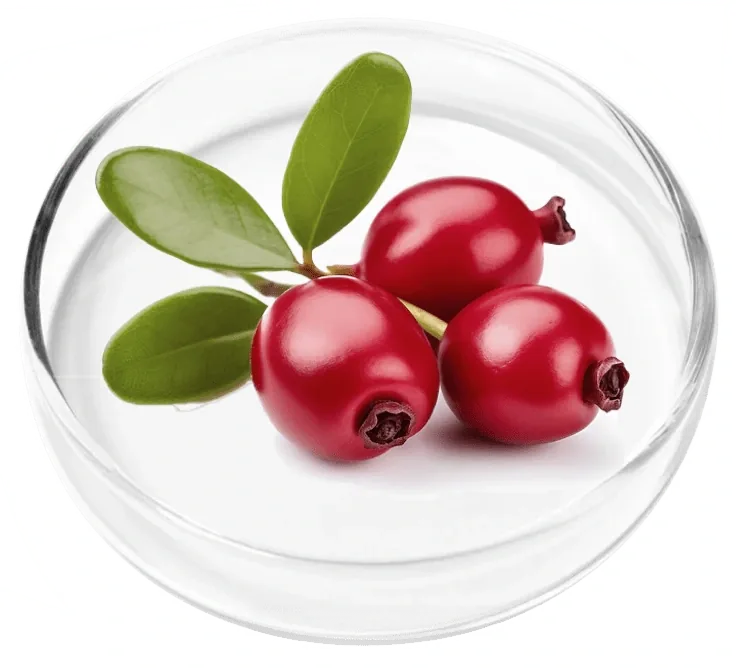
Cranberry PACs are proanthocyanidins, a group of plant compounds found in the American cranberry. FemiPro lists them through its second herbal line: "Cranberry Extract (Vaccinium macrocarpon) (berry) (std. to 30% proanthocyanidin)".
"Standardized to 30%" means 30 of every 100 parts of the extract are PACs. The label does not say how they were measured.
The extract sits second of four in the 350 mg "UTI Herbal Blend". It is the herb with the most human research behind it.
What the label tells you
- The plant: Vaccinium macrocarpon, the American cranberry
- The part: the berry
- The strength: 30% proanthocyanidin
- The place: line 2 of 4, listed by weight
What it leaves out
The weight of the extract, the PAC test method and the supplier. None of these is required for a blend (21 CFR 101.36, supplement labeling).
| Name on the label | Cranberry Extract (Vaccinium macrocarpon) (berry) (std. to 30% proanthocyanidin) |
|---|---|
| What it is | American cranberry fruit extract, standardized to 30% proanthocyanidins (PACs) |
| Place on the label | Line 2 of 4 in the 350 mg UTI Herbal Blend |
| Amount per capsule | Not printed; line 2 of 4 in the 350 mg UTI Herbal Blend. Label order caps it at 175 mg. |
| Amount used in research | Trials used many juices, tablets and doses; no single PAC dose is set |
| Strength of evidence | Moderate: fewer repeat UTIs in women prone to them; not a treatment |
| Marketed or traditional use | Urinary tract support |
| Main caution | Warfarin evidence is conflicting: ask first if you take it. Kidney-stone data are mixed. |
The math02
How many cranberry PACs are in one FemiPro capsule?
At most about 52 mg of cranberry PACs, and possibly far fewer. The label prints no cranberry amount, so the only number we can work out is a ceiling.
Blend lines are listed from most to least by weight (21 CFR 101.36, supplement labeling). Cranberry is second, so it cannot weigh more than Mimosa pudica above it. Split 350 mg evenly between those two lines and each gets 175 mg. That is the largest cranberry could be. Thirty percent of 175 mg is 52.5 mg of PACs.
There is no floor. Cranberry only has to outweigh the two lines below it.
| Case | Cranberry extract | PACs at 30% |
|---|---|---|
| Ceiling (cranberry ties with mimosa) | 175 mg | 52.5 mg |
| Example: all four herbs equal | 87.5 mg | About 26 mg |
| Example: mimosa takes 250 mg | About 40 mg | About 12 mg |
| Printed on the label | Not printed | Not printed |
The research03
Do cranberry PACs help prevent repeat UTIs?
Yes, for some groups, with moderate certainty. A 2023 Cochrane review pooled 50 trials with 8,857 people. Cranberry products lowered the risk of a symptomatic, culture-confirmed urinary tract infection by about 30% against placebo or nothing (risk ratio 0.70) (Cochrane 2023, cranberries for preventing UTIs).
For women with repeat UTIs the risk ratio was 0.74. NCCIH sums it up as about a 25% drop in repeat infections in women, while noting the results are not consistent and some studies are weak (NCCIH, Cranberry).
The 2025 US urology guideline says clinicians should offer cranberry to women with repeat UTIs (AUA/CUA/SUFU, Recurrent uncomplicated UTI guideline 2025). It names no dose, PAC level or brand.
| Group | Risk ratio | Plain reading |
|---|---|---|
| All trials vs placebo or nothing | 0.70 | About 3 in 10 fewer infections |
| Women with repeat UTIs | 0.74 | About a quarter fewer |
| Older people in care homes | 0.93 | Little or no benefit |
| Pregnant women | 1.06 | Little or no benefit |
| Adults whose bladder does not empty fully | 0.97 | Little or no benefit |
None of these trials used FemiPro. More on the trials and their doses in our guide to cranberry for UTI prevention.
Leaks04
Do cranberry PACs help with bladder leaks?
No study shows that. Cranberry research measures infections: how many women get a new UTI over months of use. It does not measure leaks, urgency or trips to the bathroom.
Most leaks come from a weak pelvic floor, an overactive bladder or both. The 2024 US guideline on overactive bladder finds the evidence insufficient to recommend herbal remedies or nutraceuticals (AUA/SUFU, Overactive Bladder guideline 2024).
So the front-label claim "Bladder Control Support" does not rest on the cranberry research. What works for leaks is plainer: pelvic-floor muscle training cured stress leaks in 56% of women in a Cochrane review, against 6% without it (Cochrane, pelvic floor muscle training for UI in women).
Find your leak pattern in bladder leaks explained, then try pelvic floor basics.
FemiPro: from $49 a bottle30 capsules · 1, 3 or 6 bottles · free US shipping · 60-day money-back guarantee
See packsActive infection05
Can cranberry PACs treat an active UTI?
No. Cranberry is studied for lowering the chance of the next infection, not for clearing one you have now. NCCIH says it is not recommended as a treatment (NCCIH, Cranberry).
The label's name, "UTI Herbal Blend", does not change that. Burning when you pee, a constant urge, cloudy or bloody urine, or pelvic pressure point to an infection that needs a clinician, who usually prescribes antibiotics. Fever, chills or back pain can mean the kidneys are involved (CDC, UTI basics).
Safety06
Is cranberry extract safe with warfarin or kidney stones?
Mostly yes, with two open questions: warfarin and kidney stones. Very large amounts can upset the stomach (NCCIH, Cranberry).
On warfarin, the evidence is mixed. NCCIH calls it conflicting (NCCIH, Cranberry). A US Pharmacopeia safety review found the warning signs came from very high intakes, not from a glass or two of juice a day (Madden 2021, cranberry safety (stones, warfarin)). Nobody has tested FemiPro with warfarin.
On kidney stones, the same review calls the data contradictory: some reports suggest higher risk, others lower (Madden 2021, cranberry safety (stones, warfarin)).
Tell your doctor or anticoagulation clinic before you start FemiPro, and keep taking prescribed medicine as directed. The capsule's other herbs bring their own flags; see supplements and medicines and the bearberry page.
Takeaway07
What should you know before relying on FemiPro's cranberry?
FemiPro's cranberry line is well chosen but small and unmeasured: at most 175 mg of extract and about 52 mg of PACs. No trial has tested the capsule, and cranberry's research is about infections, not leaks.
If repeat UTIs are your worry, ask your clinician whether cranberry suits you, and in what form. Peri- and postmenopausal women can also ask about vaginal estrogen, which the same guideline recommends to lower future UTI risk (AUA/CUA/SUFU, Recurrent uncomplicated UTI guideline 2025). The full nine-line label is compared with research on the ingredients page.
FAQ08
Cranberry questions
What are cranberry PACs?
PACs, or proanthocyanidins, are plant compounds in cranberries. They are the part most often measured in cranberry products for urinary health. FemiPro's extract is labeled as standardized to 30% PACs, but the label does not name the test method, and methods can give different numbers.
Does cranberry stop bladder leaks?
No trial shows that. Cranberry research counts urinary tract infections, not leaks or urgency. The US overactive bladder guideline finds too little evidence for herbal remedies (AUA/SUFU, Overactive Bladder guideline 2024). For stress leaks, pelvic-floor muscle training has the strongest evidence, with no supplement needed.
Can cranberry treat a UTI?
No. Cranberry is studied for lowering the chance of a repeat infection, not for clearing a current one (NCCIH, Cranberry). If you have burning, urgency, fever or back pain, see a clinician. An infection usually needs a test and antibiotics, and waiting can let it reach the kidneys.
Is cranberry safe with warfarin?
The evidence is conflicting. Warning signs in reports came mostly from very large intakes (Madden 2021, cranberry safety (stones, warfarin)), and a FemiPro capsule holds at most 175 mg of extract. Still, nobody has tested the capsule with warfarin, so ask your doctor or anticoagulation clinic before you start.
Does cranberry cause kidney stones?
The data are contradictory. A US Pharmacopeia safety review found some reports of higher stone risk and others of lower risk (Madden 2021, cranberry safety (stones, warfarin)). If you have had stones, ask your clinician before adding any cranberry product, including a capsule like FemiPro.
How much cranberry is in FemiPro?
The label does not say. Cranberry is line 2 of 4 in a 350 mg blend, so it weighs at most 175 mg, half the blend. At 30% PACs, that caps PACs at about 52 mg. The true amount could be much lower; no floor is printed.
Who wrote this09
Written and reviewed by
Pages built from the label, the sales page and linked NIH, FDA, FTC and peer-reviewed sources.
Last updated . Read our editorial standards and how we check reviews. This website is run by a U.S. stocking partner for FemiPro, not by the manufacturer or the label's distributor. We earn money when you buy through our order links.
Keep reading
More about FemiPro

U.S. stocking partner for FemiPro
Ready to try FemiPro?
Check your medicines first, then pick a pack. Every pack ships free in the US, six bottles cost the least per bottle, and each order carries the 60-day money-back guarantee.
- Secure checkout
- 60-day money-back guarantee
- Ships from the U.S.